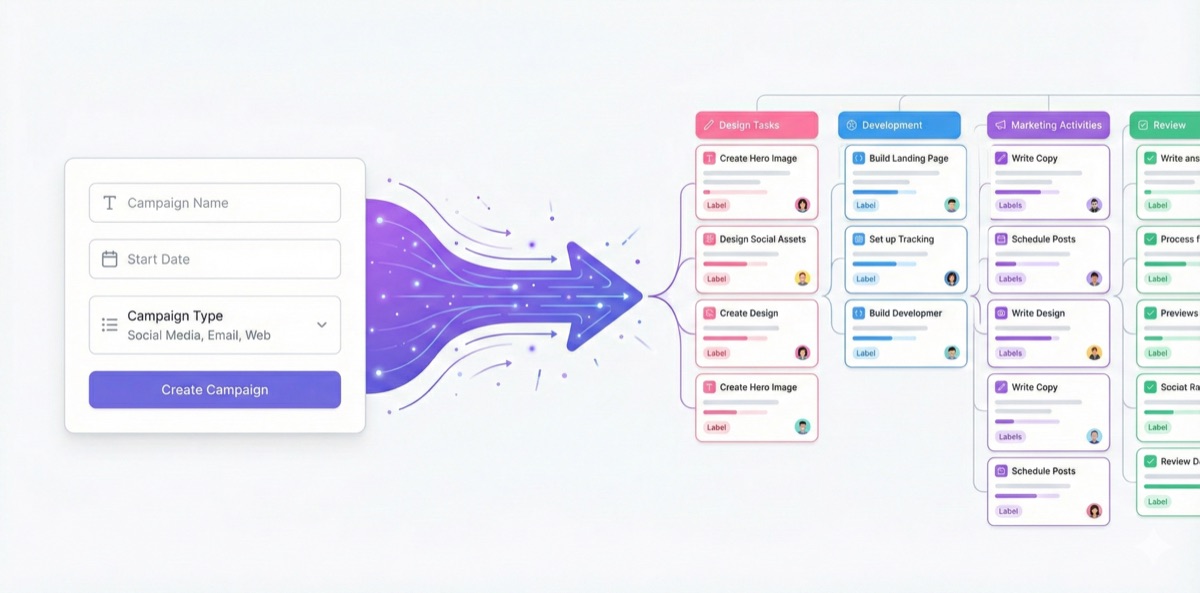
One Form, Complete Campaign Structure
It's 9 AM Monday. You just got approval for a product launch campaign. Launch date: three weeks from Friday.
You open Jira (or Asana, or Monday—same problem everywhere) and start the ritual:
Create the main campaign ticket. Add subtasks: landing page, email sequence, social posts, paid ads, press release. Set up dependencies—wait, which task blocks which? Assign team members—who's the designer on this again? Set deadlines working backward from launch. Link to the brief document. Create a separate ticket for engineering to build the landing page. Remember to add the custom fields your team uses for budget tracking. Double-check you didn't forget anything.
Two hours later, you have a campaign structure. Maybe. You'll probably discover a missing task next week when someone asks "who's handling the UTM tracking?"
We've set up hundreds of campaigns across our careers. The setup ritual is always the same. And it's always a waste of time that could be spent on actual marketing work.
What If Setup Took 3 Minutes Instead of 3 Hours?
That's not a hypothetical. We measured it.
The Same Monday, Different Outcome
Let's replay that Monday morning with BloomSig's Campaign Launcher.
You open BloomSig. Select "Product Launch" from the template menu. A short form appears—not a blank canvas, but specific questions: What's the product? When does it launch? What's the budget tier? Who's the marketing lead?
You fill in the details. Takes about two minutes.
Before you hit "Create," BloomSig shows you exactly what you're about to generate: 15 tasks organized in a logical hierarchy. Landing page design (assigned to your usual designer), engineering ticket for development (already linked to the right Jira project), email sequence, social content, paid ads setup. Dependencies already configured—the email sequence won't start until the landing page is approved. Dates calculated backward from your launch date.
One click. Three minutes total. Your complete campaign structure exists in Jira.
But here's the part that matters more than speed: it's the same structure every time.
Why Consistency Matters More Than Speed
The 92% time reduction is nice. But the real value of templates isn't speed—it's what consistency enables.
Things Stop Falling Through the Cracks
How many times has a campaign launched without an EDM to existing customers—simply because nobody remembered to add that task? Or a social post went live without the tracking UTMs because that step wasn't in someone's mental checklist?
Templates capture institutional knowledge. That campaign last quarter that performed brilliantly? Every step that made it work—including the ones that seem obvious—gets baked into the template. New campaign managers don't have to learn by failing.
Compliance Rules Enforce Themselves
"Any campaign with spend over $50K requires legal review." Great policy. But who's checking? When it's a manual step, someone eventually forgets—and you find out when Legal calls after the campaign is already live.
With templates, the rule is built in. Campaign budget over the threshold? Legal review task appears automatically. It's not a policy someone has to remember—it's just how campaigns work.
Influencer Campaigns at Scale
Running a campaign with 15 influencers? 50? Each one needs their own tracking: contract status, content delivery, review cycles, posting dates, performance metrics.
Without templates, you're either copy-pasting the same structure 50 times (and making mistakes), or everyone's doing it slightly differently (and reporting is impossible). With templates, you spin up 50 identical tracking structures in minutes—and when the CMO asks "how many influencers have submitted content?", you can actually answer.
Creative Teams Can Be Measured Like Engineering
In-house design teams often struggle with workload visibility. How many assets did the team produce this quarter? What's the average turnaround time? Where are the bottlenecks?
When every campaign uses the same structure with the same task types, you can finally measure: 47 videos produced, 156 static designs, average turnaround 3.2 days. That data supports hiring decisions, identifies training needs, and gives creative teams the recognition they deserve.
Know-How Compounds Over Time
Templates aren't static. When someone figures out a better workflow—a review step that catches problems earlier, a dependency that prevents delays—you update the template. Every future campaign benefits automatically.
It's like code reuse for marketing operations. The best practices of your most experienced campaign managers become the default for everyone.
Here's what we measured during our pilot program:
| Metric | Before | After | Change |
|---|---|---|---|
| Setup time per campaign | 2.5 hours | 12 minutes | -92% |
| Missing tasks discovered later | 23% of campaigns | 3% of campaigns | -87% |
| Inconsistent structure issues | Frequent | Rare | — |
| Time to first task start | 1-2 days | Same day | — |
The consistency improvement—from 23% of campaigns missing tasks to 3%—that's where the real value is.
Templates That Match How You Actually Work
BloomSig comes with templates for common campaign types—Product Launch, Promotional Campaign, Influencer Partnership—but the real power is customization.
Every marketing team has their own way of working. Maybe your company requires legal review on all ad copy. Maybe you have a dedicated analytics setup phase. Maybe your influencer campaigns have a unique approval flow for sponsored content.
Instead of forcing you into our workflow, Campaign Launcher lets you build templates that match yours:
Capture your best campaign structure once. That campaign last quarter that ran perfectly? Turn it into a template. Every task, every dependency, every assignment—captured and repeatable.
Set smart defaults. Your senior designer always handles product launch creative? Make that the default assignment. Your legal team needs 5 business days for review? Build that buffer into the timeline automatically.
Enforce standards without policing. When the template includes legal review, nobody forgets to add it. When budget tracking fields are required, they get filled in. The template does the remembering so your team can focus on the work.
What the CMO Actually Sees
Here's the part that matters to leadership:
When every campaign follows the same structure, you can finally answer questions like:
- "How many campaigns are currently in creative review?"
- "What's our average time from kickoff to launch?"
- "Where are the bottlenecks in our process?"
Not with guesswork. Not with "let me check with each campaign manager." With actual data, pulled from a system where every campaign is structured the same way.
One Marketing VP told us: "I used to have no idea what was happening until something was late. Now I can see every campaign's status without asking anyone. That visibility alone was worth the switch."
Getting Started
Campaign Launcher is part of BloomSig, coming soon to the Atlassian Marketplace. Start with our standard templates, run a few campaigns, then customize based on what you learn.
The goal isn't to change how you work. It's to capture how you work at your best—and make that the default.
Ready to stop wasting hours on campaign setup? Join the early access waitlist →
This is Part 4 of our series on marketing operations in Jira. Start from the beginning → | Read Part 5: Creative Approvals →
This article is part of