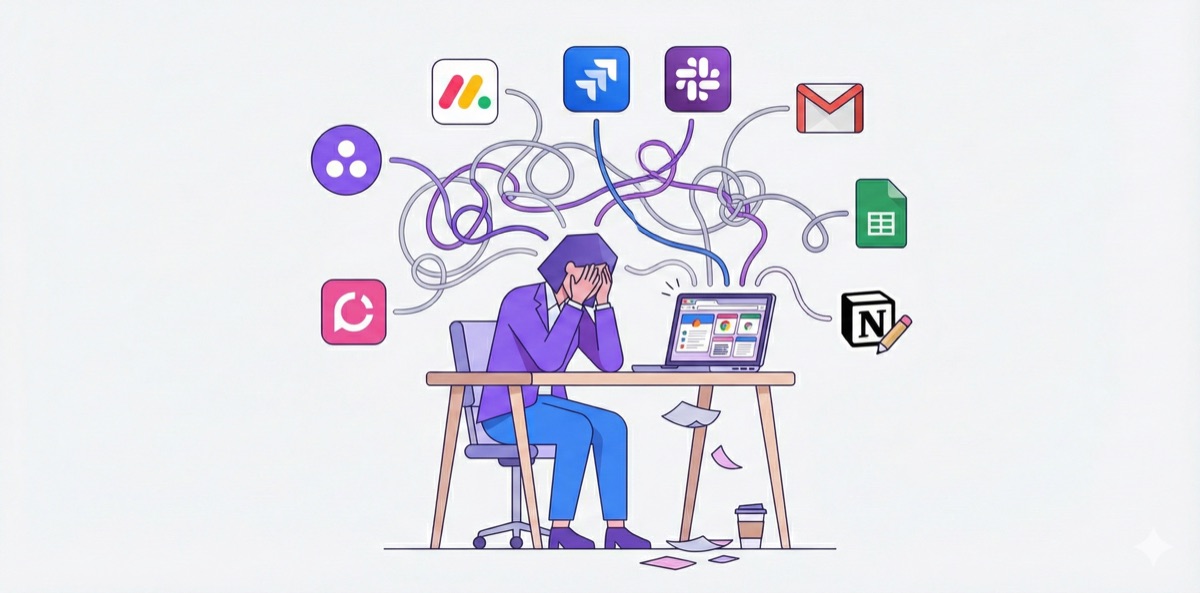
The Hidden Cost of Your Marketing Tech Stack
Your engineering team uses Jira. Your product team uses Jira. Your design team probably has a board in Jira too. Your company is already paying for Jira—likely Premium or Enterprise tier, with SSO, advanced permissions, and compliance features baked in.
But your marketing team? They're paying $15/seat/month for Asana. Or Monday. Or both. On top of the Jira licenses they're not using.
We've been there. Our team has collectively spent 15+ years in marketing operations—navigating multi-layered approval workflows at Fortune 500 brands and leading consumer electronics companies, while also shipping campaigns at startup speed in high-growth tech companies where every hour counts. Whether it's a 12-person marketing pod iterating daily or a global team coordinating 50+ concurrent campaigns, we've felt the friction firsthand. And we learned a painful lesson: the real cost of your marketing tech stack isn't the subscription fees. It's everything else.
Why This Problem Is Getting Worse
Tool fragmentation isn't new. But three shifts have made it significantly more painful in the past few years:
1. The MarTech explosion. The marketing technology landscape grew from ~150 tools in 2011 to over 11,000 in 2023. Every new tool promises to solve one problem—and creates two new integration headaches.
2. Remote and hybrid work. When everyone was in the same office, you could yell across the room: "Hey, did engineering see my request?" Now that question lives in Slack threads, email chains, and comment sections across five different tools. The coordination tax has multiplied.
3. Marketing and Product are more intertwined than ever. Growth marketing, PLG motions, product-led campaigns—modern marketing requires constant engineering collaboration. What used to be a quarterly handoff is now a daily dependency. And daily dependencies across disconnected tools break daily.
If your team could survive tool fragmentation five years ago, that doesn't mean you can afford it now.
The Tool Tax: A Real Calculation
According to a 2023 Forrester study, knowledge workers spend 23% of their time switching between applications and searching for information. Let's translate that into actual dollars for a 10-person marketing team:
| Cost Type | Calculation | Annual Cost |
|---|---|---|
| Duplicate licensing | Jira seats unused + Asana $15/seat × 10 × 12 | $3,600+ |
| Productivity loss | 23% × $100K avg salary × 10 people | $230,000 |
| Sync meetings | 2 hrs/week × 50 weeks × $50/hr × 10 people | $50,000 |
| Integration maintenance | 0.5 FTE dedicated to keeping tools connected | $50,000 |
| IT overhead | Security reviews, SSO setup, compliance audits | $5,000+ |
| Total | $338,600+ |
That "cheap marketing tool" is actually costing you $34K per person per year when you factor in the hidden costs—and you're literally paying for two project management systems.
And this doesn't even include opportunity costs—the campaigns that launched late, the leads that went cold while waiting for assets, the revenue you'll never know you lost.
What This Looks Like Day-to-Day
Here's a scenario we see constantly:
Your campaign manager needs a landing page. She creates a task in Asana with all the requirements. But the dev team works in Jira. So someone has to:
- Create a Jira ticket
- Copy the requirements
- Link back to the Asana task (somehow)
- Remember to update both when status changes
Two weeks later, the engineer says "this wasn't in the sprint." The campaign manager says "I submitted this three weeks ago." Both are technically right—they're just looking at different systems.
The downstream effects:
- One delayed campaign (missed the product launch window)
- One frustrated engineer (who looks unresponsive but wasn't)
- One marketing manager who now pads all her timelines by two weeks "just in case"
- One CMO wondering why marketing velocity is declining
Who Feels This Pain?
The same fragmentation hits different roles differently:
If you're a CMO or VP Marketing: This shows up as missed revenue targets, finger-pointing between teams, and a nagging sense that your org is slower than it should be. You're spending budget on tools that should make things faster, but velocity keeps declining.
If you're in Marketing Ops: You're the one maintaining the duct tape. You've become an expert in Zapier, Unito, and "custom integrations" that break every time someone changes a field name. Half your job is keeping systems in sync instead of enabling campaigns.
If you're a Campaign Manager: You've been burned enough times that you pad every timeline by two weeks. You've learned to "manage up" by constantly pinging engineering in Slack because you don't trust the tools to surface your requests. You're exhausted.
The Visibility Gap
Here's another cost that rarely shows up in ROI calculations: leadership can't see marketing work.
Your CEO opens Jira to check on the product roadmap. They can see every engineering sprint, every feature in progress, every bug being fixed. But marketing? That's a black box. "Go ask the marketing team" becomes the answer to every question about campaign status.
And it gets worse when it comes to spend.
The CFO's nightmare: Marketing is running campaigns across Google, Meta, TikTok, and a dozen other platforms. Each platform has its own dashboard. Each campaign manager tracks their own budget in their own spreadsheet. Finance doesn't see the actual spend until the invoices arrive at the end of the month.
By then, it's too late. That campaign that was supposed to spend $50K? It burned through $80K in the first two weeks because nobody caught the pacing issue. Or worse—it underspent by 40% because the creative wasn't approved in time, and now you're explaining to the board why you didn't hit your pipeline targets.
When marketing lives in a separate system, you don't just lose collaboration efficiency. You lose real-time visibility into one of your largest budget line items.
And there's a subtler cost: cultural separation.
In many tech companies, marketing operates as a parallel universe. Different tools, different rhythms, different vocabulary. Engineering ships features; marketing "does campaigns." The system separation reinforces the narrative that marketing is somehow different—less rigorous, less measurable, less central to the business.
But the most successful tech companies we've worked with treat marketing as a core function, not a support function. They understand that in a PLG world, the line between product and marketing barely exists. Growth loops, activation funnels, retention campaigns—these aren't "marketing projects." They're product strategy.
When your systems are unified, it's easier to build a unified culture. Marketing work becomes visible. Dependencies become clear. And maybe, just maybe, marketing stops being "that team in Asana" and starts being part of the same mission.
The Unification Question
The solution seems obvious: just use one tool. But here's why that's harder than it sounds:
Option A: Everyone uses Jira
Marketing teams try Jira and bounce off. We've seen this firsthand—we ran three separate Jira training sessions for a 20-person marketing team. Six months later, adoption had dropped to 20%. The interface is built for software development. Workflows don't match marketing needs. "Sprints" don't make sense for a Q4 brand campaign. Marketers don't think in story points.
Option B: Everyone uses Asana/Monday
Good luck convincing your engineering org to migrate. They have years of process built around Jira. Their deployment tools integrate with Jira. Their CI/CD pipelines report to Jira. Their performance reviews reference Jira velocity. You're not moving engineering off Jira. Ever.
Option C: "We'll just integrate them"
We've tried this too. At one company, we built a 37-step Zapier workflow to sync Asana and Jira. It broke at least once a month—usually right before a major launch. We eventually hired a part-time contractor just to maintain integrations. And we still had two systems, two sources of truth, and two places where things could go wrong.
A Different Approach
What if the tool that everyone already uses could actually work for marketing?
Not by forcing marketing teams to think like engineers. But by bringing marketing workflows—campaign templates, creative approvals, content calendars—natively into the platform your company already pays for.
That's what we're building with BloomSig: marketing-native workflows that run on Jira. Not "Jira for marketers"—that's been tried and it doesn't work. Instead, a layer that understands how marketing actually operates, built on top of the platform your engineering team will never leave.
But before we talk more about solutions, let's talk about the specific moments where this fragmentation hurts the most.
Ever had a campaign launch delayed because engineering "didn't see the deadline"? You're not alone. In Part 2, we'll walk through exactly how this happens—step by step—and why integration tools won't save you.
This series is for Marketing Ops leaders, Campaign Managers, and CMOs at tech companies who are tired of tool fragmentation.
Want to see BloomSig in action? Join the early access waitlist →
This is Part 1 of our series on marketing operations in Jira. Read Part 2: Campaign Launch Day →
This article is part of
Marketing Tools Reimagined
All articles in this series
- 1The Hidden Cost of Your Marketing Tech Stack
- 2Campaign Launch Day: A Horror Story
- 3Marketing Workflows, Native to Jira
- 4One Form, Complete Campaign Structure
- 5Creative Approvals Without the Email Chaos
- 6Why Your Content Calendar Lies to You