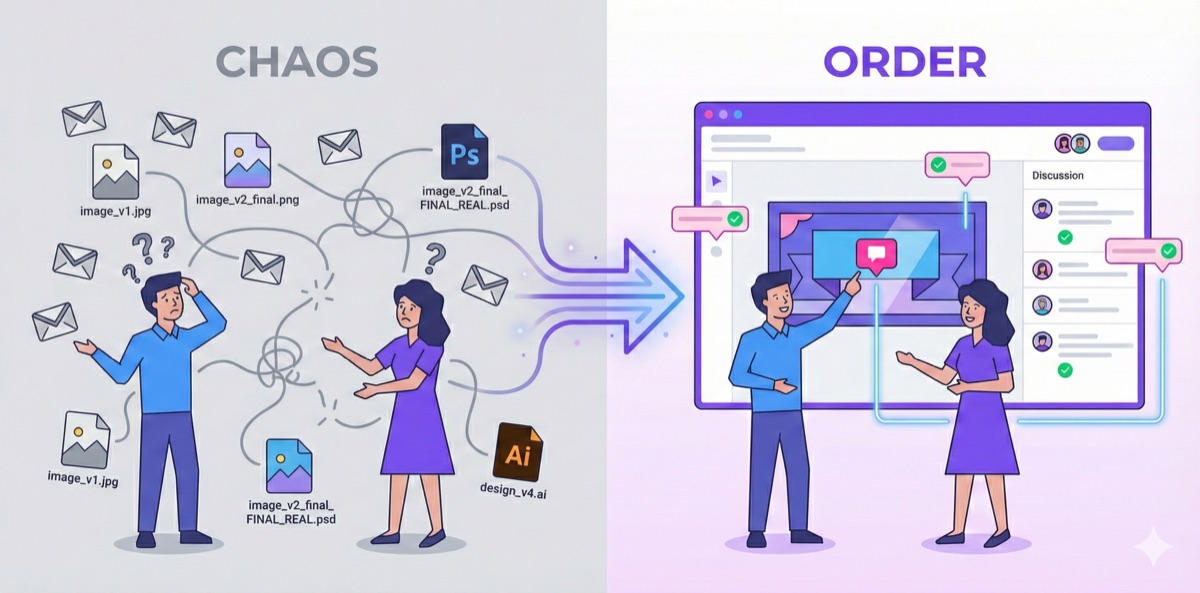
Creative Approvals Without the Email Chaos
It's Thursday afternoon. Lisa, your designer, has been waiting for feedback on a campaign banner for two days.
She uploaded v1 to Google Drive on Tuesday and emailed the link to three stakeholders: the Brand Manager, the Product Marketing lead, and the Campaign Manager who requested the asset.
The Brand Manager replied within hours—detailed feedback in the email body. Good.
The Product Marketing lead opened the image, took a screenshot, annotated it in Preview with arrows and circles, and attached it to a reply-all. Different feedback, partially contradicting what Brand said. Okay.
The Campaign Manager is at a conference. She saw the email on her phone, glanced at the image on a 6-inch screen, and replied "looks good to me!" She didn't see the other feedback threads.
Lisa synthesizes what she can and creates v2. Emails a new link.
The Brand Manager replies—but to the v1 thread. With feedback on v1. "Did we ever resolve the color issue?"
Lisa creates v3 based on the mixed signals. Now it's Thursday. The campaign was supposed to launch Friday.
Someone finally asks the question everyone's thinking: "Wait, which version are we even on? And did anyone loop in Legal?"
The file in the Google Drive folder is now named: Banner_Q4Promo_v3_final_FINAL_v2_LisaEdits.png
Sound familiar?
The Real Cost of Feedback Chaos
This isn't just annoying. It's expensive in ways that don't show up on any dashboard.
Designer productivity: How much time does your designer spend tracking down feedback? Checking email, then Slack, then the Google Doc comment that someone mentioned in a meeting? We've seen designers spend 30% of their time on feedback archaeology instead of actual design work.
Extra revision cycles: When feedback comes in piecemeal—some on Monday, some on Wednesday, some after you've already moved to v3—you end up with unnecessary rounds. We tracked one campaign that went through 7 versions when 3 would have sufficed if feedback had been consolidated.
Launch delays: Creative approval is often the longest pole in the tent. When approvals bottleneck because stakeholders are slow to respond to scattered email threads, the entire campaign timeline slips.
And it gets worse when external stakeholders are involved.
Your agency needs to review the creative. Your client's brand manager needs to approve. That influencer needs to sign off on their sponsored post.
What are your options?
- Create guest accounts in your internal tools (IT hates this, security hates this, and half the time the external person never figures out the login)
- Manage everything through email (multiply the chaos by 10)
- Pay for a dedicated proofing tool like Filestage or Frame.io (another subscription, another silo, another login to remember)
What If Feedback Had a Home?
Here's what creative review looks like when it's built into the same system where your campaign lives:
The designer uploads the creative to the Jira issue. Not to Google Drive, not to a separate tool—to the task itself.
Stakeholders click directly on the image to comment. "The logo needs to be 20% larger" pinned to the exact spot they're talking about. No more "the thing in the upper right corner, no the other upper right."
Comments thread into discussions. The designer asks a clarifying question. The brand manager responds. The conversation stays attached to that specific annotation. Nothing gets lost.
Version 2 uploads, and you can see what changed. Side-by-side comparison. Which feedback was addressed? Click through the annotations—this one's resolved, that one's still pending.
Then the client needs to approve.
You click "Generate Review Link." Send the URL to your client. They open it in their browser—no login required, no account creation, no "I can't figure out how to access Jira." They see the creative. They can annotate. They click Approve.
That approval is recorded in Jira. The task status updates. Downstream tasks (ad trafficking, email build) automatically move to "Ready to Start." The campaign keeps moving.
A Real Scenario
Let's make this concrete.
Without BloomSig: Your designer creates a banner for a product launch. She emails it to three internal stakeholders. Stakeholder A replies with feedback. Stakeholder B replies to Stakeholder A's email with different feedback. Stakeholder C is traveling and doesn't respond for two days. The designer makes changes based on A and B, sends v2. Stakeholder C finally responds—to the v1 email—with feedback that conflicts with what A said. Now there's a meeting to "align on creative direction." Three days lost.
With BloomSig: Designer uploads the banner to the campaign task. All three stakeholders get notified. They each add annotations directly on the image. The designer can see all feedback in one view—and can see where comments conflict. She flags the conflict in a comment: "@StakeholderA and @StakeholderC, you're asking for opposite things on the CTA color. Can you align?" They hash it out in the thread. Designer creates v2 with clear direction. Approved in 24 hours.
The difference isn't magic. It's just having one place where feedback lives, instead of five.
Why This Matters
We've lived through the email chaos ourselves. At one company, a $50K photo shoot sat unused for three weeks because feedback got lost in an email thread. At another, a campaign launched with the wrong logo version because someone approved in the old thread while the designer was working from the new one.
These aren't edge cases. They're Tuesday.
The external review feature came directly from our own pain—having to create "guest accounts" for clients, or worse, screenshotting Jira comments into PowerPoint decks for client review. There had to be a better way.
What Leadership Sees
For Marketing Directors and CMOs, creative approval chaos shows up as:
- "Why is creative always the bottleneck?"
- "How many campaigns are stuck waiting for approval right now?"
- "What's our average time from first draft to final approval?"
When creative review happens in Jira alongside everything else, these questions have answers. You can see which creatives are pending review, who's holding things up, and where the process breaks down. Not through status meetings—through dashboards.
One Brand Director told us: "I used to find out about creative delays when campaigns launched late. Now I can see a creative has been sitting in review for 3 days and ping the right person before it becomes a crisis."
Getting Started
Creative Review is part of BloomSig, coming soon to the Atlassian Marketplace. If you're using Campaign Launcher, creative review tasks are automatically created with the right dependencies—so approved creative is always a prerequisite for launch tasks.
The external review feature alone might be worth it. No more guest accounts, no more email threads, no more explaining Jira to people who just need to approve a banner.
Ready to end the "Final_v2_FINAL.pdf" madness? Join the early access waitlist →
This is Part 5 of our series on marketing operations in Jira. Start from the beginning → | Read Part 6: Why Your Content Calendar Lies to You →
This article is part of
Marketing Tools Reimagined
All articles in this series
- 1The Hidden Cost of Your Marketing Tech Stack
- 2Campaign Launch Day: A Horror Story
- 3Marketing Workflows, Native to Jira
- 4One Form, Complete Campaign Structure
- 5Creative Approvals Without the Email Chaos
- 6Why Your Content Calendar Lies to You