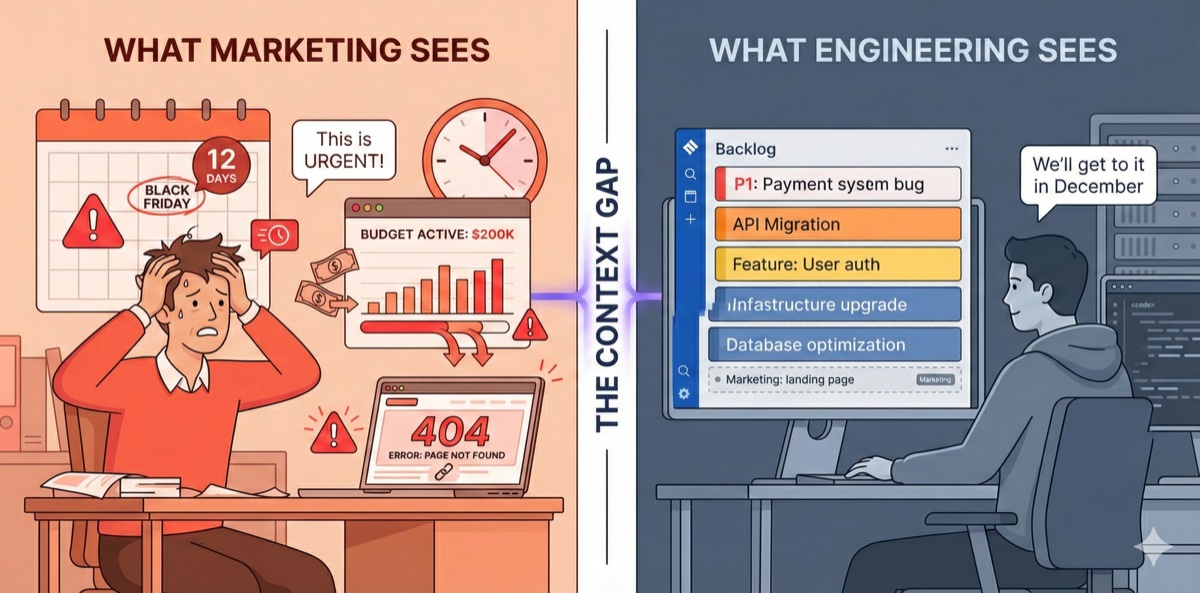
Why Engineering Always Puts Your Campaign Last (And How to Change That)
It's Monday morning standup. You've been waiting two weeks for the right moment to bring this up.
"Hey, quick question—any update on that Black Friday landing page? We need a countdown timer component. The ads are already scheduled."
The engineering lead glances at the backlog on screen. "Q4's pretty packed. We've got the payment refactor, the API migration, and three P1 bugs. Earliest we could look at it is... mid-December?"
Black Friday is November 29th.
You try to explain. You mention the $200K ad spend that will have nowhere to land. You mention the CMO who approved the budget last month. But the conversation has already moved on. Someone's asking about the deployment pipeline.
You leave the meeting feeling like you just asked for a favor—not like you're driving company revenue.
This Isn't a Scheduling Problem
Here's the uncomfortable truth: engineering probably does have capacity. They shipped three features last sprint. They're not lazy. They're not ignoring you.
They just don't know why they should care.
When I was running marketing operations at a global DTC brand, we tracked this obsessively. Every quarter, an average of 4 campaigns were delayed because marketing requests sat at the bottom of engineering's backlog. At $200K expected revenue per campaign, that's $800K in risk exposure—every single quarter.
And it wasn't because engineering was understaffed. It was because our requests looked, to them, like low-priority "support work."
The Translation Problem
Marketing and engineering speak different languages. And I don't mean Python versus PowerPoint.
| When marketing says... | Engineering hears... |
|---|---|
| "This is urgent" | "Everything is urgent to them" |
| "The CMO needs this" | "Political pressure, not real priority" |
| "It's a simple landing page" | "They don't understand technical complexity" |
| "We need it by Friday" | "Another unrealistic deadline" |
None of this is malicious. It's just that your request arrives stripped of context.
The Jira ticket says: "Create landing page with countdown timer."
What it doesn't say:
- This page will receive 50,000 visitors during Black Friday
- We've already committed $200K in ad spend driving traffic to this URL
- Every day of delay costs us ~$30K in wasted ad budget
- If we miss the window, we miss our Q4 pipeline target
Engineers don't deprioritize your work because they don't care. They deprioritize it because they don't know why they should care.
The Priority Queue in Engineering's Head
Here's something marketing leaders rarely see: how engineering actually prioritizes work.
In most engineering orgs, there's an unwritten hierarchy:
- System is down — Drop everything
- Security vulnerability — Drop almost everything
- P1 bugs affecting customers — This sprint, guaranteed
- Roadmap features — Committed to leadership, in the OKRs
- Tech debt — Important but perpetually deferred
- "Support requests" — Everything else
Guess where "make a landing page for marketing" lands?
Your request isn't being ignored because it's unimportant. It's being ignored because it looks like it belongs in category 6—and nobody ever tells engineering otherwise.
The $800K Miscommunication
Let me show you the math we ran at that DTC brand.
We audited every engineering request from marketing over two quarters. Here's what we found:
| Request Type | Avg. Delay | Revenue at Risk | Requests/Quarter |
|---|---|---|---|
| Campaign landing pages | 2.3 weeks | $180K | 6 |
| Email template updates | 1.8 weeks | $45K | 12 |
| Tracking pixel installation | 3.1 weeks | $220K | 4 |
| A/B test implementation | 2.7 weeks | $95K | 8 |
The total? Over $2.1M in revenue was at risk every quarter because of delays. Not because engineering couldn't do the work. Because they didn't know it mattered.
When we showed this data to the VP of Engineering, his response was telling: "I had no idea these requests were connected to revenue targets. We treated them like internal tooling requests."
Tactical Fixes: What You Can Do Tomorrow
Before we talk about systemic change, here are three things you can implement this week.
1. Translate "urgent" into "$$$"
Stop saying "this is urgent." Start saying "every day of delay costs $X."
Before:
"We need the landing page ASAP. Black Friday is coming up."
After:
"This landing page supports our Black Friday campaign. We have $200K in ad spend launching Nov 15. Without the page live by Nov 14, we'll be driving paid traffic to a 404. Daily burn rate: $28K."
The second version doesn't feel like marketing hyperbole. It feels like a business case.
2. Join sprint planning (or at least send a preview)
Most marketing teams only engage with engineering when they need something. By then, the sprint is already planned.
Instead: at the start of each quarter, share your campaign calendar with the engineering lead. Flag the dates that require engineering support. Let them plan around you instead of treating every request as an interruption.
3. Write tickets in engineering's language
Here's a template that works:
## Business Context
- Campaign: Black Friday 2024
- Revenue target: $500K attributed
- Launch date: Nov 15 (hard deadline—ads already scheduled)
- If delayed: $28K/day in wasted ad spend

## Technical Requirements
- Responsive landing page (mobile-first)
- Countdown timer component (end: Nov 29 11:59 PM PST)
- CMS-editable headline and CTA text
- A/B test ready (2 variants)

## Success Criteria
- Page load time < 2s
- Works on Safari, Chrome, Firefox
- Tracking pixels installed (GA4, Meta, TikTok)

## Dependencies
- Design: Complete (Figma link attached)
- Copy: Complete (in doc attached)
- Tracking specs: From analytics team (attached)
This ticket doesn't look like a "marketing request." It looks like a legitimate engineering spec with clear business justification.
The Bigger Fix: Building a Revenue-Aware Engineering Culture
Tactical fixes help. But if you want to fundamentally change how engineering thinks about marketing work, you need to change the culture.
Show engineers the impact of their work
Here's something most companies get wrong: engineers ship the ticket and move on. They never find out what happened.
That landing page they built? It converted at 4.2%—0.8% above benchmark. The countdown timer created urgency that drove $340K in attributed revenue.
But nobody told them.
When I started sharing campaign results with our engineering partners, everything changed. We'd send a Slack message after every major campaign:
"Black Friday results are in. That landing page you rushed to finish? It drove $340K in revenue—12% above target. The countdown timer you added increased conversion by 0.8%. Thank you."
Engineers are motivated by impact. If they never see the impact, they'll assume there isn't any.
Invite engineers into the war room
For our biggest campaigns, we started inviting the engineers who built the key components to join the launch war room. Not to fix bugs (though they did that too)—but to watch real-time dashboards showing conversions, revenue, and user behavior.
Something shifts when an engineer watches their code generate revenue in real time. The landing page stops being "a marketing request" and starts being "a revenue system I built."
One engineer told me afterward: "I never understood why you cared so much about page load time. Now I get it—every 100ms matters."
Rebrand "marketing support" as "growth engineering"
Words matter. "Support" sounds like a favor. "Growth engineering" sounds like strategy.
At some of the best companies I've worked with, there's no such thing as a "marketing support ticket." There's a Growth Engineering team—a dedicated pod that treats marketing and product work with equal rigor.
Their OKRs include metrics like:
- Campaign deployment velocity
- Landing page conversion rates
- Marketing infrastructure uptime
When growth engineering ships a landing page, it's not because marketing asked nicely. It's because converting visitors is their job.
The Systemic Problem: Tools Make This Worse
Everything I've described so far assumes you can actually get context from marketing to engineering. But here's the reality at most companies:
- Campaign strategy lives in Google Docs
- Marketing tasks live in Asana or Monday
- Engineering work lives in Jira
- Revenue data lives in Tableau or Looker
- The connection between them lives in someone's head
When your campaign manager creates a request, here's what happens:
- She writes the requirements in Asana
- Someone (maybe her, maybe a project manager) creates a Jira ticket
- The requirements get copy-pasted—and compressed
- The "why" gets lost in translation
- The engineer sees "make landing page" without context
- The ticket sits at the bottom of the backlog
The tools aren't connected. So the context can't flow.
What Would Actually Fix This
Imagine a different world:
- When a campaign is created, engineering sees the revenue target attached to their Jira tickets
- When an engineer opens a task, they see exactly which campaign it supports and when ads launch
- When a deadline slips, everyone—marketing and engineering—sees the financial impact in real time
- When a campaign succeeds, the engineers who contributed are automatically credited
This isn't about "integrating Asana with Jira." We've tried that. 37-step Zapier workflows that break monthly. Sync tools that duplicate tickets incorrectly. Band-aids on a structural problem.
What you need is marketing context that lives natively where engineering works.
That's what we're building with BloomSig. Not "Jira for marketers"—that's been tried and marketers hate it. Instead: marketing workflows that run on Jira, with revenue context attached to every engineering task automatically.
When an engineer opens their Jira board, they don't just see "create landing page." They see "Black Friday Campaign — $500K revenue target — ads launch in 6 days."
Context changes everything.
Start With One Conversation
You don't need a new tool to start fixing this. You need a conversation.
This week: Take your engineering lead to coffee. Show them your campaign calendar for next quarter. Explain which campaigns need engineering support and why. Share the revenue targets.
Most engineering leaders I've met genuinely want to help. They just don't know what marketing is trying to accomplish. They see tickets, not strategy.
Give them context, and watch priorities shift.
This month: After your next major campaign, send the results to everyone who contributed—including engineering. Show them the revenue impact of their work. Make them part of the success story.
This quarter: Audit your marketing-to-engineering request flow. How much context survives the handoff? How much gets lost? Where are the gaps?
The friction between marketing and engineering isn't inevitable. It's a symptom of systems that don't share context. Fix the context problem, and you fix the priority problem.
Tired of being at the bottom of the backlog? BloomSig brings marketing context directly into Jira, so engineering sees the revenue impact of every request.
This article is part of our series on marketing and engineering collaboration. Want to go deeper?