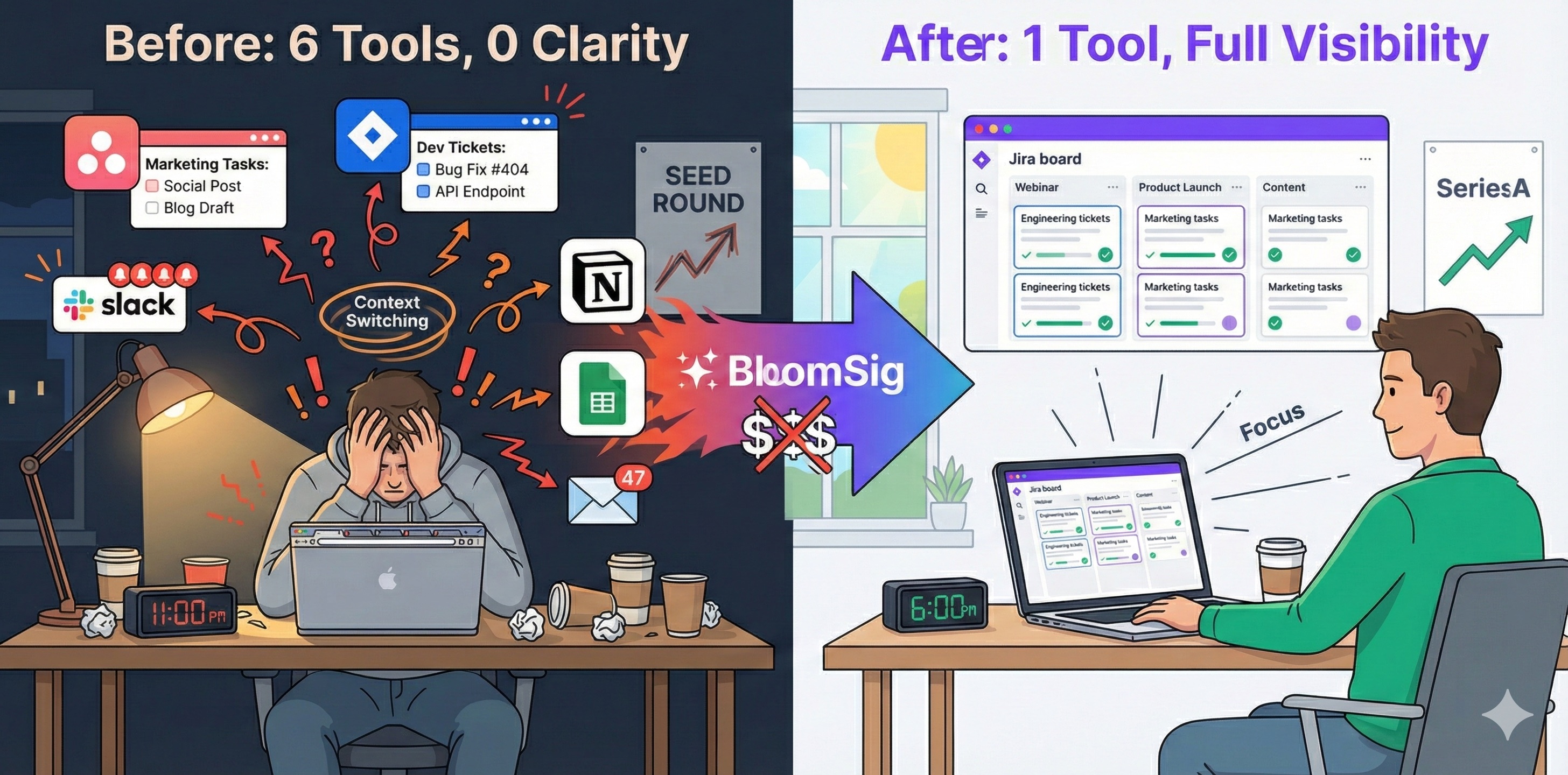
You Don't Need Another Tool: Marketing for Startups Already Using Jira
It's 11 PM on a Tuesday. You're the co-founder of a 12-person startup. Today you've reviewed three pull requests, jumped on two customer calls, and now you're trying to plan next week's Product Hunt launch.
You open Asana to update the marketing campaign status. Then Jira to check if the landing page feature is done. Back to Asana to adjust the timeline. Then Jira again to leave a comment for the engineer. Then Asana to mark a task complete. Then Jira to create a bug ticket for something you just noticed.
By midnight, you've spent more time syncing two project management tools than actually planning the launch.
Sound familiar?
Why Your Startup Chose Jira (And Why That Was Right)
Let's be honest: you didn't pick Jira by accident.
Maybe your founding team came from Google, Meta, or another tech company where Jira was the standard. Maybe you're building B2B software and your customers expect to see a proper development process. Maybe you knew from day one that you'd need enterprise-grade tooling when you scale.
Whatever the reason, you made a deliberate choice. Jira integrates with your CI/CD pipeline. It connects to GitHub or GitLab. It's where your sprint planning happens, your bugs get tracked, your product roadmap lives.
That was the right call.
The problem isn't Jira. The problem is what happened next.
The Two-Tool Trap
Here's the pattern we see at almost every tech startup:
- Engineering sets up Jira (the obvious choice)
- Someone starts doing marketing (maybe a founder, maybe the first marketing hire)
- They try Jira for marketing tasks
- It feels wrong—sprints don't fit campaigns, story points don't make sense
- Someone suggests Asana "just for marketing"
- Now you have two project management tools
- Things start falling through the cracks
At a Fortune 500, you hire a Marketing Ops person to manage this chaos. At a 12-person startup, that person is you—the founder who's also doing sales calls, the head of growth who's also running customer support, or the engineer who writes blog posts on Fridays.
The Real Cost of "Just One More Tool"
Let's do some startup math:
| Cost | Calculation | Annual |
|---|---|---|
| Jira (already paying) | $0 extra | $0 |
| Asana Business (10 seats) | $25/user × 10 × 12 | $3,000 |
| Sync time between tools | 3 hrs/week × $75/hr × 52 | $11,700 |
| Missed handoffs (1 per month) | 4 hrs to fix × $75 × 12 | $3,600 |
| Context switching tax | 2 hrs/week × $75/hr × 52 | $7,800 |
| Total hidden cost | $26,100/year |
For a seed-stage startup, $26K is real money. It's three months of runway. It's a contractor who could be building features. It's the ad budget for your next campaign.
And what do you get for it? Two places to check instead of one. Two systems to keep in sync. Two sources of "truth" that inevitably contradict each other.
"But Jira Isn't for Marketing"
We hear this constantly. And honestly? Traditional Jira isn't great for marketing.
Try explaining "story points" to someone planning an influencer campaign. Try fitting a three-month brand launch into two-week sprints. Try finding your content calendar in a backlog of 200 engineering tickets.
But that doesn't mean you need a separate tool.
What if Jira could understand marketing workflows? What if you could:
- Create a campaign and have all the subtasks auto-generated (landing page, emails, social posts, ads)
- See your content calendar as an actual calendar, not a list of tickets
- Get creative approvals without email chains
- Track marketing work alongside engineering work—because at a startup, they're deeply connected anyway
That's what BloomSig does. It's not "Jira for marketers"—it's marketing-native workflows that run on the platform your team already uses.
What This Actually Looks Like
Before BloomSig:
Your head of growth needs to launch a webinar campaign:
- Create tasks in Asana for the marketing work
- Create a Jira ticket for the registration page
- Manually link them (somehow)
- Check Asana for design status
- Check Jira for dev status
- Update both when things change
- Miss the deadline because the designer was waiting on copy in Asana while checking Jira
After BloomSig:
- Fill out a campaign form: "Webinar Campaign"
- BloomSig creates all tasks in Jira—design, dev, copy, promotion
- Everyone sees everything in one place
- Campaign launches on time
No sync meetings. No duplicate updates. No "wait, which tool is that in?"
The Startup Advantage
Here's the thing about being small: you can move fast.
You don't have years of Asana workflows to migrate. You don't have a Marketing Ops team defending their territory. You don't need six months of change management and training sessions.
You can just... stop paying for Asana. This week. And run everything in Jira with BloomSig.
That's $3,000/year back in your bank account. That's 5 hours a week back in your calendar. That's one less tool to manage, one less password to remember, one less thing that can break.
Who Is This For?
BloomSig isn't for everyone. If you're a 500-person company with a dedicated Marketing Ops team and established Asana workflows, there's a switching cost to consider.
But if you're:
- A tech startup (10-50 people) that chose Jira deliberately
- A team where the "marketing person" wears five other hats
- Already paying for Jira and wondering why you also pay for Asana
- Tired of things falling through the cracks between two project management tools
Then you're exactly who we built this for.
At a startup, simplicity is a competitive advantage. Every hour spent syncing tools is an hour not spent talking to customers, shipping features, or closing deals.
Use that advantage.
Ready to simplify? BloomSig is free for teams under 10 users. Get started →
This article is for startup founders, heads of growth, and technical teams who are tired of running marketing in a separate tool from everything else.